Every year, it starts the same way.
Buying expensive Christmas lights, climbing ladders, untangling cords, and that frustration… ughh…!
Wait, not just that, but your frustration gets doubled when you realize that the lights aren’t enough for the entire house. Sometimes you buy four extra boxes you didn’t need, and sometimes you notice that one strand is short. Sadly!
The truth is, figuring out how many Christmas lights you need is not as complicated as it sounds. It just takes a little planning and strategy.
We believe that it’s not about how many Christmas lights you decorate with; it’s all about how they are placed. After all, clean rooflines and evenly spaced bulbs elevate curb appeal. Right?
In this blog post, we’ll discuss how to calculate Christmas lights for your home so you can decorate with confidence without being frustrated.
Decide What You Actually Want to Light Up.
Wondering how many Christmas lights do I need for my house?
Well, you can figure it out by deciding what you actually want to light up. Think about your goal. For example, what are you going for?
- A simple roofline outline?
- Roofline + garage?
- Windows trimmed in lights?
- Wrapped columns?
- Trees and bushes?
- Full front yard display?
Why? Because the number of lights you want depends on how much of the house you want glowing.
Some homeowners in Dallas want a subtle, clean, and decent look. While others want an extremely bright and bold display.
So, there is no right answer; it’s all about your style.
How to Calculate Christmas Lights for Your Home?
Let’s start with the most crucial area of the house—your roofline. And for measuring that, you simply need:
- A tape measure
- A notepad
- A rough sketch of the house front
After that, measure:
- The horizontal roof edges
- The garage peaks
- Any upper-level rooflines
- Dormers, if you have them
Write everything in the notepad and then add it up.
- Main roofline: 45 feet
- Garage: 22 feet
- Upper peak: 18 feet
Total = 85 feet
That’s a real number to work with.
How Many Lights Do You Need Per Foot?
That’s another step in the calculation process, which depends on the type of lights you are using. For example, if you are using the large C9 bulbs, they will usually be spaced 12 inches apart. So, if the roofline measures 85 feet, you may need:
- 85 bulbs
- Or about 85 feet of C9 light strand
What Happens When You Are Using Mini Lights?
Mini lights are comparatively quite dense. Most strands have:
- 100 bulbs per 33 feet
- That’s about 3 bulbs per foot
For rooflines, people double them up for more brightness.
So for 85 feet:
- One layer = 85 feet
- Double layer = 170 feet
Mini lights create a soft glow. However, you will need more footage.
Let’s Talk About Windows
That’s where most people underestimate. First, measure the width and the height. For example, your window is 3 feet wide and 4 feet tall. Let’s do some math:
3 + 4 + 3 + 4 = 14 feet per window
So, if you have 6 windows:
14 × 6 = 84 feet
This adds up fast.
Do Not Ignore the Garage Frame
Since garage doors are big, they EAT lights. For example, a standard 2-car garage might measure 16 feet wide and 7 feet tall. To outline:
16 + 7 + 16 + 7 = 46 feet
This is approximately half your roofline amount just for the garage.
How Many Lights Do You Need for the Tree?
It’s Christmas; we cannot forget the tree, of course. So, how many lights you need for the tree entirely depends on:
- Height
- Trunk thickness
- How dense do you want it
Rule of Thumb for Wrapping Trees
100 lights per vertical foot of tree
So:
- 6-foot tree = 600 lights
- 10-foot tree = 1,000 lights
Bushes and Shrubs
A 3-foot shrub usually needs:
- 100–150 lights
Larger hedges?
- 200–300 lights each
If you line 10 bushes across the front of your house, that could be:
- 1,000–2,000 lights just in landscaping
Quick Estimate by Home Size
| Home size | Roofline only | Roofline + Garage | Full front display |
| Small single-storey | 100-200 feet of lights | 150-250 feet | 500–1,000 total feet |
| Medium two-storey | 200-300 feet | 250-350 feet | 1,000–2,500 total feet |
| Large custom home | 300+ feet | 350-500+ feet | 3,000–5,000+ lights |
Should You Buy Extra Lights?
Well, that’s another confusion many homeowners in Texas face. They can’t decide whether they should buy some extra lights or not.
Well, the answer is yes! Add at least 10–15% extra footage.
Why?
- Mistakes happen
- Connections need Slack
- Corners require extra length
- Some strands fail
Realizing that one strand is short at 10 pm is not fun!
What If You Want a Professional Look?
Instead of DIY, many homeowners prefer professional services, and that’s actually a good choice. Here’s what separates DIY from professional service:
- Even spacing
- Straight lines
- Hidden wires
- Clean corners
- Symmetry
Professionally installed systems calculate:
- Exact roof pitch
- Precise spacing
- Balanced brightness
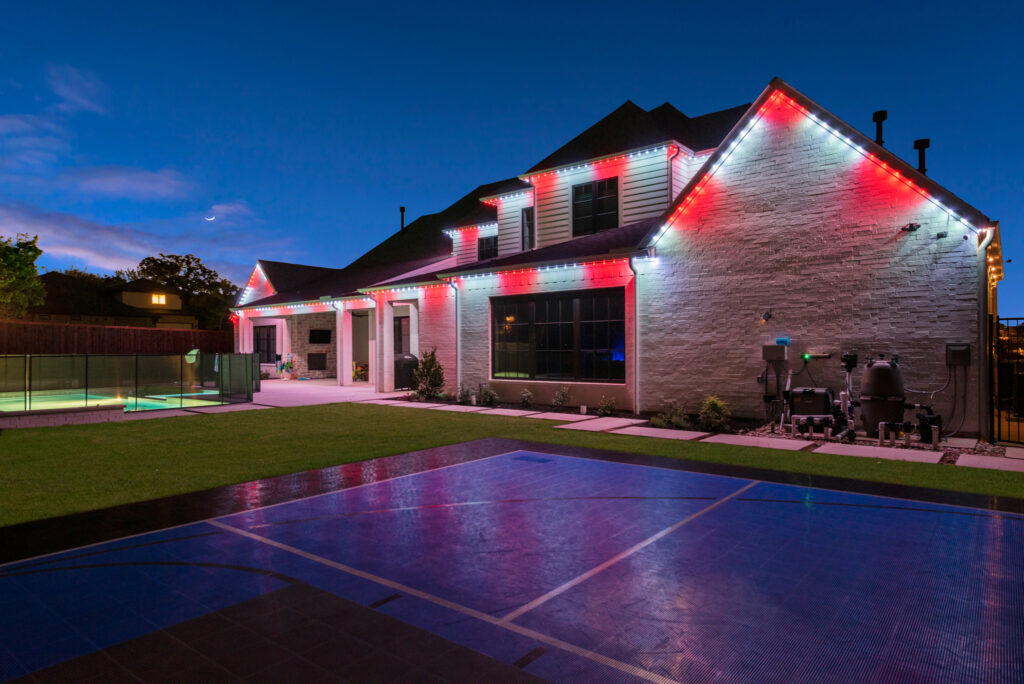
This means no sagging strands and no visible extension cords. Just clean and consistent lines.
How Many Lights Does a Permanent System Use?
Permanent LED lights often use:
- Fewer bulbs
- Better placement
- Brighter output
- Cleaner coverage
Because they’re installed strategically—not randomly. And of course, you don’t need hundreds of extra lights when they are positioned correctly.
Important Safety Considerations
Texas weather isn’t gentle.
We deal with:
- Wind
- Rain
- Ice
- Sudden temperature swings
Temporary lights can:
- Shift out of place
- Pull loose
- Short out
Permanent systems are:
- Secured properly
- Rated for outdoor durability
- Installed with safety in mind
- That matters when you’re 20 feet off the ground.
Final Thoughts—How Many Christmas Lights Do I Need?
At the end of the day, figuring out how many Christmas lights you need really comes down to thoughtful planning and knowing what kind of look you want.
A well-measured, balanced display will always look better than strands added at random, and taking the time to calculate your footage can save you stress, money, and multiple trips to the store.
If you’d rather skip the measuring, guessing, and climbing altogether, Trimlight DFW can handle it for you with a custom, professionally installed permanent lighting system designed specifically for your home. That way, you get a clean, polished look year after year—without ever having to count another strand.